Documentation Index
Fetch the complete documentation index at: https://nixtla.io/docs/llms.txt
Use this file to discover all available pages before exploring further.
Introduction
Pricing decisions significantly impact retail demand. TimeGPT makes it possible to forecast product demand while incorporating price as a key factor, enabling retailers to evaluate how different pricing scenarios might affect sales. This approach offers valuable insights for strategic pricing decisions.
This tutorial demonstrates how to use TimeGPT for scenario analysis by forecasting demand under various pricing conditions. You’ll learn to incorporate price data into forecasts and compare different pricing strategies to understand their impact on consumer demand.
What You’ll Learn
- How to forecast retail demand using price as an exogenous variable
- How to run what-if scenarios with different pricing strategies
- How to compare baseline, increased, and decreased price forecasts
- How to interpret price sensitivity in demand forecasts
How to Forecast Sales with Pricing Scenarios
Step 1: Import required packages
Import the packages needed for this tutorial and initialize your Nixtla client:
import pandas as pd
import os
from nixtla import NixtlaClient
Initialize the Nixtla client:
nixtla_client = NixtlaClient(
api_key='my_api_key_provided_by_nixtla'
)
Step 2: Load the M5 dataset
Let’s see an example on predicting sales of products of the M5 dataset. The M5 dataset contains daily product demand (sales) for 10 retail stores in the US.
First, we load the data using datasetsforecast. This returns:
Y_df, containing the sales (y column), for each unique product (unique_id column) at every timestamp (ds column).
X_df, containing additional relevant information for each unique product (unique_id column) at every timestamp (ds column).
from datasetsforecast.m5 import M5
Y_df, X_df, S_df = M5.load(directory=os.getcwd())
Y_df.head(10)
| unique_id | ds | y |
|---|
| FOODS_1_001_CA_1 | 2011-01-29 | 3.0 |
| FOODS_1_001_CA_1 | 2011-01-30 | 0.0 |
| FOODS_1_001_CA_1 | 2011-01-31 | 0.0 |
| FOODS_1_001_CA_1 | 2011-02-01 | 1.0 |
| FOODS_1_001_CA_1 | 2011-02-02 | 4.0 |
| FOODS_1_001_CA_1 | 2011-02-03 | 2.0 |
| FOODS_1_001_CA_1 | 2011-02-04 | 0.0 |
| FOODS_1_001_CA_1 | 2011-02-05 | 2.0 |
| FOODS_1_001_CA_1 | 2011-02-06 | 0.0 |
| FOODS_1_001_CA_1 | 2011-02-07 | 0.0 |
For this example, we will only keep the additional relevant information from the column sell_price. This column shows the selling price of the product, and we expect demand to fluctuate given a different selling price.
X_df = X_df[['unique_id', 'ds', 'sell_price']]
X_df.head(10)
| unique_id | ds | sell_price |
|---|
| FOODS_1_001_CA_1 | 2011-01-29 | 2.0 |
| FOODS_1_001_CA_1 | 2011-01-30 | 2.0 |
| FOODS_1_001_CA_1 | 2011-01-31 | 2.0 |
| FOODS_1_001_CA_1 | 2011-02-01 | 2.0 |
| FOODS_1_001_CA_1 | 2011-02-02 | 2.0 |
| FOODS_1_001_CA_1 | 2011-02-03 | 2.0 |
| FOODS_1_001_CA_1 | 2011-02-04 | 2.0 |
| FOODS_1_001_CA_1 | 2011-02-05 | 2.0 |
| FOODS_1_001_CA_1 | 2011-02-06 | 2.0 |
| FOODS_1_001_CA_1 | 2011-02-07 | 2.0 |
Step 3: Forecast demand using price as an exogenous variable
In this example, we forecast for a single product (FOODS_1_129_) across all 10 stores. This product exhibits frequent price changes, making it ideal for modeling price effects on demand. Learn more about using exogenous variables in TimeGPT.
products = [
'FOODS_1_129_CA_1', 'FOODS_1_129_CA_2', 'FOODS_1_129_CA_3', 'FOODS_1_129_CA_4',
'FOODS_1_129_TX_1', 'FOODS_1_129_TX_2', 'FOODS_1_129_TX_3',
'FOODS_1_129_WI_1', 'FOODS_1_129_WI_2', 'FOODS_1_129_WI_3'
]
Y_df_product = Y_df.query('unique_id in @products')
X_df_product = X_df.query('unique_id in @products')
Merge the sales (y) and price (sell_price) data into one DataFrame:
df = Y_df_product.merge(X_df_product)
df.head(10)
| unique_id | ds | y | sell_price |
|---|
| FOODS_1_129_CA_1 | 2011-02-01 | 1.0 | 6.22 |
| FOODS_1_129_CA_1 | 2011-02-02 | 0.0 | 6.22 |
| FOODS_1_129_CA_1 | 2011-02-03 | 0.0 | 6.22 |
| FOODS_1_129_CA_1 | 2011-02-04 | 0.0 | 6.22 |
| FOODS_1_129_CA_1 | 2011-02-05 | 1.0 | 6.22 |
| FOODS_1_129_CA_1 | 2011-02-06 | 0.0 | 6.22 |
| FOODS_1_129_CA_1 | 2011-02-07 | 0.0 | 6.22 |
| FOODS_1_129_CA_1 | 2011-02-08 | 0.0 | 6.22 |
| FOODS_1_129_CA_1 | 2011-02-09 | 0.0 | 6.22 |
| FOODS_1_129_CA_1 | 2011-02-10 | 3.0 | 6.22 |
Let’s investigate how the demand, our target y, of these products has evolved in the last year of data.
nixtla_client.plot(df, unique_ids=products, max_insample_length=365)
We see that in the California stores (with a CA_ suffix), the product has sold intermittently, whereas in the other regions (TX and WY) sales where less intermittent. Note that the plot only shows 8 (out of 10) stores.
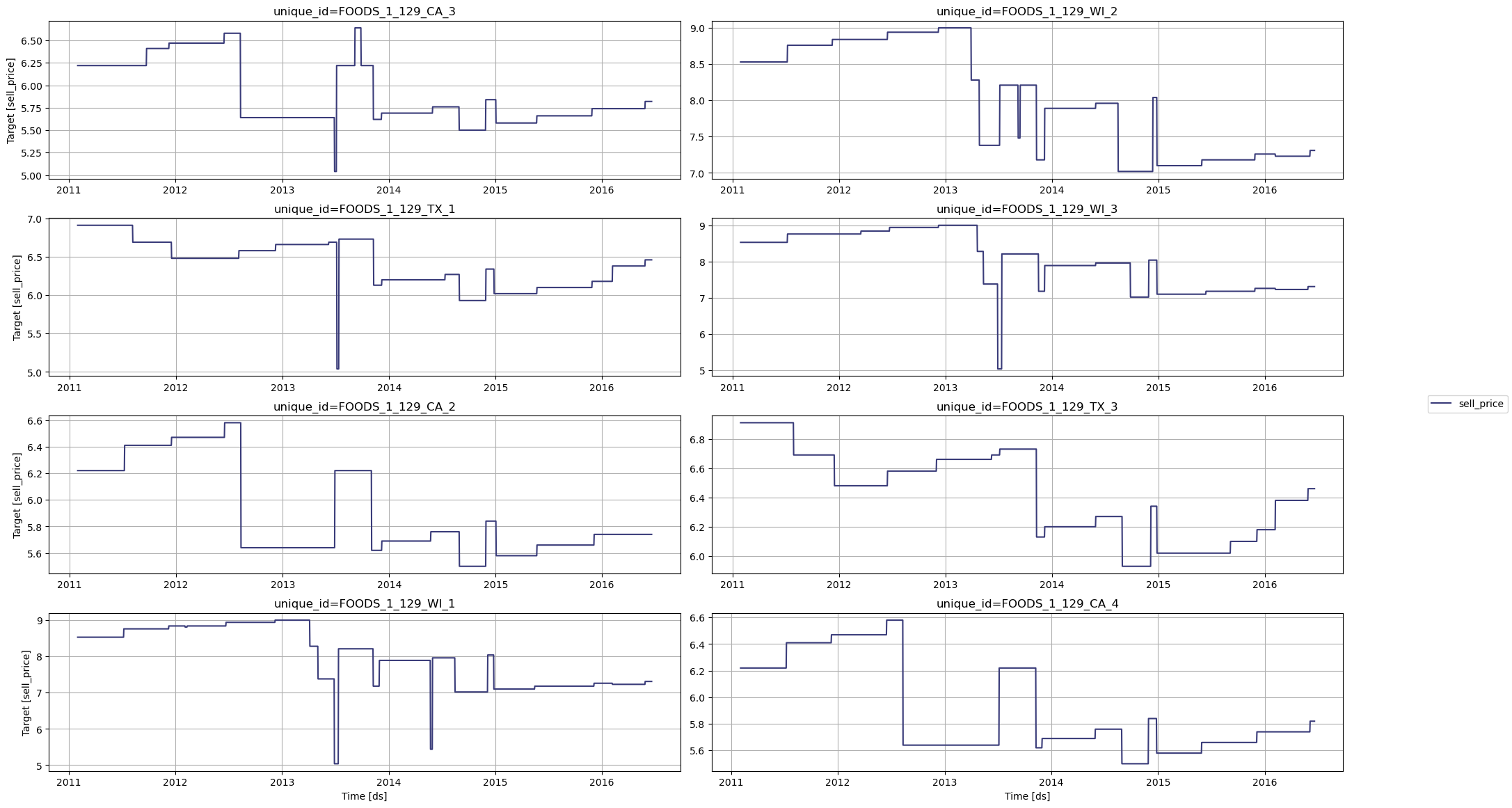
Next, we look at the sell_price of these products across the entire data available.
nixtla_client.plot(df, unique_ids=products, target_col='sell_price')
We find that there have been relatively few price changes (about 20 in total) over the period 2011 to 2016.
Let’s turn to our forecasting task. We will forecast the last 28 days in the dataset.
To use the sell_price exogenous variable in TimeGPT, we have to add it as future values. Therefore, we create a future values dataframe, that contains the unique_id, the timestamp ds, and sell_price.
future_ex_vars_df = df.drop(columns = ['y'])
future_ex_vars_df = future_ex_vars_df.query("ds >= '2016-05-23'")
future_ex_vars_df.head(10)
| unique_id | ds | sell_price |
|---|
| FOODS_1_129_CA_1 | 2016-05-23 | 5.74 |
| FOODS_1_129_CA_1 | 2016-05-24 | 5.74 |
| FOODS_1_129_CA_1 | 2016-05-25 | 5.74 |
| FOODS_1_129_CA_1 | 2016-05-26 | 5.74 |
| FOODS_1_129_CA_1 | 2016-05-27 | 5.74 |
| FOODS_1_129_CA_1 | 2016-05-28 | 5.74 |
| FOODS_1_129_CA_1 | 2016-05-29 | 5.74 |
| FOODS_1_129_CA_1 | 2016-05-30 | 5.74 |
| FOODS_1_129_CA_1 | 2016-05-31 | 5.74 |
| FOODS_1_129_CA_1 | 2016-06-01 | 5.74 |
Next, we limit our input dataframe to all but the 28 forecast days:
df_train = df.query("ds < '2016-05-23'")
df_train.tail(10)
| unique_id | ds | y | sell_price |
|---|
| FOODS_1_129_WI_3 | 2016-05-13 | 3.0 | 7.23 |
| FOODS_1_129_WI_3 | 2016-05-14 | 1.0 | 7.23 |
| FOODS_1_129_WI_3 | 2016-05-15 | 2.0 | 7.23 |
| FOODS_1_129_WI_3 | 2016-05-16 | 3.0 | 7.23 |
| FOODS_1_129_WI_3 | 2016-05-17 | 1.0 | 7.23 |
| FOODS_1_129_WI_3 | 2016-05-18 | 2.0 | 7.23 |
| FOODS_1_129_WI_3 | 2016-05-19 | 3.0 | 7.23 |
| FOODS_1_129_WI_3 | 2016-05-20 | 1.0 | 7.23 |
| FOODS_1_129_WI_3 | 2016-05-21 | 0.0 | 7.23 |
| FOODS_1_129_WI_3 | 2016-05-22 | 0.0 | 7.23 |
Now, we can generate forecasts using TimeGPT (28 days ahead):
timegpt_fcst_df = nixtla_client.forecast(
df=df_train,
X_df=future_ex_vars_df,
h=28
)
timegpt_fcst_df.head()
| unique_id | ds | TimeGPT |
|---|
| FOODS_1_129_CA_1 | 2016-05-23 | 0.875594 |
| FOODS_1_129_CA_1 | 2016-05-24 | 0.777731 |
| FOODS_1_129_CA_1 | 2016-05-25 | 0.786871 |
| FOODS_1_129_CA_1 | 2016-05-26 | 0.828223 |
| FOODS_1_129_CA_1 | 2016-05-27 | 0.791228 |
We plot the forecast, the actuals and the last 28 days before the forecast period:
nixtla_client.plot(
df[['unique_id', 'ds', 'y']],
timegpt_fcst_df,
max_insample_length=56
)
Step 4: What-If Scenario Forecasting with Price Changes
What happens when we change the price of the products in our forecast period? Let’s see how our forecast changes when we increase and decrease the sell_price by 5%.
price_change = 0.05
future_ex_vars_df_plus = future_ex_vars_df.copy()
future_ex_vars_df_plus["sell_price"] *= (1 + price_change)
future_ex_vars_df_minus = future_ex_vars_df.copy()
future_ex_vars_df_minus["sell_price"] *= (1 - price_change)
Let’s create a new set of forecasts with TimeGPT.
timegpt_fcst_df_plus = nixtla_client.forecast(df_train, future_ex_vars_df_plus, h=28)
timegpt_fcst_df_minus = nixtla_client.forecast(df_train, future_ex_vars_df_minus, h=28)
Rename and combine the scenario forecasts:
timegpt_fcst_df_plus = timegpt_fcst_df_plus.rename(columns={'TimeGPT':f'TimeGPT-sell_price_plus_{price_change * 100:.0f}%'})
timegpt_fcst_df_minus = timegpt_fcst_df_minus.rename(columns={'TimeGPT':f'TimeGPT-sell_price_minus_{price_change * 100:.0f}%'})
timegpt_fcst_df = pd.concat([timegpt_fcst_df,
timegpt_fcst_df_plus[f'TimeGPT-sell_price_plus_{price_change * 100:.0f}%'],
timegpt_fcst_df_minus[f'TimeGPT-sell_price_minus_{price_change * 100:.0f}%']], axis=1)
timegpt_fcst_df.head(10)
| unique_id | ds | TimeGPT | TimeGPT-sell_price_plus_5% | TimeGPT-sell_price_minus_5% |
|---|
| FOODS_1_129_CA_1 | 2016-05-23 | 0.875594 | 0.847006 | 1.370029 |
| FOODS_1_129_CA_1 | 2016-05-24 | 0.777731 | 0.749142 | 1.272166 |
| FOODS_1_129_CA_1 | 2016-05-25 | 0.786871 | 0.758283 | 1.281306 |
| FOODS_1_129_CA_1 | 2016-05-26 | 0.828223 | 0.799635 | 1.322658 |
| FOODS_1_129_CA_1 | 2016-05-27 | 0.791228 | 0.762640 | 1.285663 |
| FOODS_1_129_CA_1 | 2016-05-28 | 0.819133 | 0.790545 | 1.313568 |
| FOODS_1_129_CA_1 | 2016-05-29 | 0.839992 | 0.811404 | 1.334427 |
| FOODS_1_129_CA_1 | 2016-05-30 | 0.843070 | 0.814481 | 1.337505 |
| FOODS_1_129_CA_1 | 2016-05-31 | 0.833089 | 0.804500 | 1.327524 |
| FOODS_1_129_CA_1 | 2016-06-01 | 0.855032 | 0.826443 | 1.349467 |
As expected, demand increases when we reduce the price and decreases when we increase it. A cheaper product leads to higher sales and vice versa.
Finally, let’s plot the forecasts for our different pricing scenarios, showing how TimeGPT forecasts a different demand when the price of a set of products is changed.
nixtla_client.plot(
df[['unique_id', 'ds', 'y']],
timegpt_fcst_df,
max_insample_length=56
)
In the graphs we can see that for specific products for certain periods the discount increases expected demand, while during other periods and for other products, price change has a smaller effect on total demand.
Conclusion
What-if forecasting with TimeGPT enables data-driven pricing decisions by:
- Modeling demand sensitivity to price changes
- Comparing multiple pricing scenarios simultaneously
- Incorporating exogenous variables for realistic predictions
This scenario analysis approach helps retailers optimize pricing strategies and maximize revenue while understanding demand elasticity.
Next Steps
Important Considerations
- This method assumes that historical demand and price behaviour is predictive of future demand, and omits other factors affecting demand. To include these other factors, use additional exogenous variables that provide the model with more context about the factors influencing demand.
- This method is sensitive to unmodelled events that affect the demand, such as sudden market shifts. To include those, use additional exogenous variables indicating such sudden shifts if they have been observed in the past too.